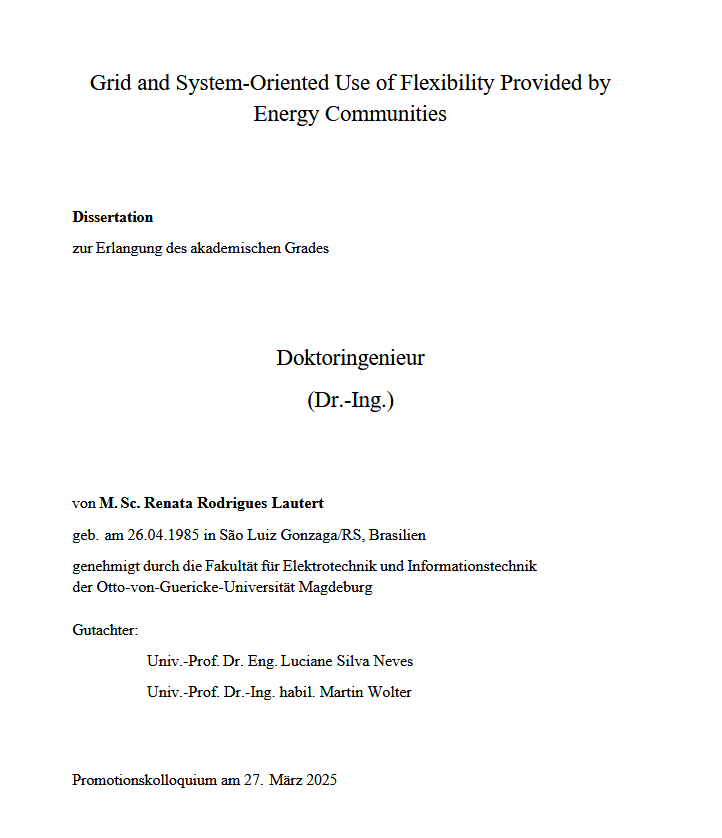
Grid and system-oriented use of flexibility provided by energy communities
DOI:
https://doi.org/10.24352/UB.OVGU-2025-085Keywords:
Distributed generation, Energy community, Power system, Storage systemsAbstract
In the current energy transition scenario, the power system has been incorporating actions aimed at decentralizing energy generation, digitalizing the system, decarbonizing, dereg- ulating and democratizing access to electricity. The concept of an energy community (EC) matches these aspects, promoting sustainability and increasing flexibility. The aim of this dissertation is to develop a control model for an EC that encompasses three different levels of flexibility and incentives for the use of flexibility. The simulated EC operates exclusively with renewable energy sources, uses a battery energy storage system (BESS) and integrates an electric vehicle (EV). Power dispatch was implemented using rule-based and optimization methods based on mixed-integer linear programming. The EC is inserted into the energy market, allowing transactions with the grid using a real-time tariff. Economic viability was assessed by calculating the daily operating cost. The main objective of the optimization was to minimize costs while prioritizing the use of available renewable resources. The analysis was conducted considering four days rep- resentative of the seasons. Scenarios of excess generation and low demand, along with low generation and high demand, were simulated to validate the proposed methodology. The three levels of flexibility were configured using adjustable parameters, including the initial and final state of charge of the BESS, the weighting coefficients for charging and discharging the BESS and the EV. These levels range from F1, the most flexible, to F3, the most conservative. Incentives in the form of rewards were introduced in accordance with the EC use of flexibility. In addition, an analysis of the voltage levels on the EC buses was performed, verifying compliance with the normative standards. The results demonstrated that the optimization model was more efficient in managing energy, guaranteeing that loads were met throughout the period analyzed. The EC's rev- enue increased by 30% in the worst-case scenario and exceeded three times the revenue, in the most beneficial scenario when using the optimized method. The behavior of BESS and EV was crucial both technically and economically, as the strategy of charging in times of surplus or low tariffs and discharging in times of deficit or high prices increased flexibility and reduced costs. In all scenarios, voltages remained within regulatory limits, even under extreme conditions. The proposed model has been shown to promote flexibil- ity and efficiency, ensuring safe operation in alignment with sustainability objectives.
Downloads
Published
Issue
Section
License
Copyright (c) 2025 Res Electricae Magdeburgenses. Magdeburger Forum zur Elektrotechnik

This work is licensed under a Creative Commons Attribution-ShareAlike 4.0 International License.