
Archives
-
Special Issue for the 19th Conference on Modelling Fluid Flow (CMFF'25)
Vol. 46 No. 1 (2026)This volume of the European Journal of Engineering Mechanics contains select papers presented at the 19th event of the international conference series on fluid flow technologies, the Conference on Modelling Fluid Flow (CMFF’25). It took place in Budapest (Hungary) between Aug. 26th and 29th, 2025, with more than 150 participants from 15 countries. The next event is scheduled for the end of August 2028. Please bookmark https://www.cmff.hu or sign up for the mailing list via email (cmff@gpk.bme.hu) if you would like to be kept informed.
As its title suggests, the conference covers all fields of fluid mechanics. Key results from theoretical, numerical, as well as experimental studies have been presented in Budapest, with the most significant papers being invited for journal publication. The present special issue reveals the complex nature of fluid flows, particularly those that are intrinsically multi-scale and involve multi-physics. The thirteen papers contained in this issue span fundamental studies of fluid dynamics from micro-scale (such as micro-bubbles) up to full-scale applications (such as quadcopters and pump tribology). Single-phase and two-phase flows, heat transfer, and even chemical reactions are considered. Of course, suitable models must be developed and validated, particularly those regarding turbulence – as this question remains one of the most intriguing topics of fluid dynamics.
We hope that you enjoy reading the content!
Dominique Thévenin, János Vad, Csaba Horváth, Esztella Balla and Gábor JanigaContent:
- An experimental study with high-speed PIV to characterize the laminar - turbulent transition in helically coiled reactors (Conrad Müller, Péter Kováts, Dominique Thévenin and Katharina Zähringer)
- Numerical investigation of a lifted methane/air jet flame using stochastic map-based turbulence modeling (Tommy Starick and Heiko Schmidt)
- Influence of the Reynolds number and the axial fan impeller blade angle on the turbulent swirling jet flow (Novica Z. Jankovic, Đorđe S. Čantrak, Dejan B. Ilić, Miloš S. Nedeljković)
- Development of a cylindrical-blade wind turbine driven by a necklace vortex (Tsutomu Takahashi, Ryuga Sadaoka and Yasunori Sato)
- CFD modelling of the thermo- and hydrodynamic capabilities of long-necked plesiosaurs (Miguel Marx, Róbert-Zoltán Szasz and Johan Lindgren)
- Quantitative analysis of surface mode oscillations of acoustically excited microbubbles (Dániel Nagy, Péter Kalmár, Kálmán Klapcsik and Ferenc Hegedűs)
- Cavitation bubble near a wall: Sensitivity to modeling conditions (Bo Wang, Zhidian Yang and Francesco Romanò)
- Enhanced LES-based turbulent subcooled flow boiling prediction (Hanan Aburema, Bruce C. Hanson, Michael Fairweather and Marco Colombo)
- LES and DES of flow and ice accretion on wind turbine blades (Johan Revstedt, Robert Szász, and Stefan Ivanell)
- Numerical study of liquid embolization in intravascular treatment using a moving particle semi-implicit method (Takuya Natsume, Marie Oshima, and Nobuhiko Mukai)
- Analysis of externally excited nonlinear Mathieu equation model for floating bodies (Erik Silva Fujiyama, Josh Davidson and Tamás Kalmár-Nagy)
- Definition and computation of a flutter safety margin for quadcopters by chained 2-DOF aeroelastic models (Dávid András Horváth, János Lelkes, Balázs Farkas and Tamás Kalmár-Nagy)
- Design and validation of a pump test rig for tribological and thermal analysis of mechanical seals toward condition monitoring development (David Heel, Peter Meusburger, Helmut Benigni, Johannes Bauer, Ferdinand Werdecker and Maximilian Raith)
-
Special Issue for the 8th International Conference on Material Modeling (ICMM8)
Vol. 44 No. 3 (2024)Preface to the Special Issue on Material Modelling:
The current special issue collects research topics that were presented at the 8th International Conference on Material Modelling (ICMM8), which took place at Loughborough University London on 15-17 July 2024. The conference was organized by Vadim Silberschmidt and his team of the Mechanics of Advanced Materials Research Group at Loughborough University.
Material modelling has become a field of high scientific importance in the last decades. Although there are many workshops, meetings, colloquia, etc. on specific materials and particular applications, an ICMM conference series is dedicated to material modelling and its various aspects. To this end, the aim of the ICMM conference is to bring together researchers from various fields of material modelling and material characterization and to cover all aspects of material modelling. The conference series provides the opportunity for interaction with and exchanges between scientists working in different subareas of mechanics of materials, who otherwise would not come into contact with each other.
This biennial conference is the eighth in the ICMM series. The first ICMM took place in Dortmund (Germany) in 2009. The conference since then was held in Paris (France), Warsaw (Poland), Berkeley (USA), Rome (Italy), Lund (Sweden), and Cape Town (South Africa).
Some 120 participants from 22 countries attended the conference. The largest delegations were from UK (39), Germany (22), France (17), India (6) and USA (5). The participation confirms a strong interest in conferences focussing on the modelling and understanding the behaviour of materials.
The next conference of the series - ICMM9 - will be organized in Prague, Czech Republic, in September 2026.
Vadim Silberschmidt
Albrecht Bertram
-
Special Issue for the 18th German-Polish / Polish-German Workshop
Vol. 44 No. 2 (2024)Preface to the first Special Issue on Dynamical Problems in Mechanical Systems:
The current special issue collects research topics that were presented at the 18th German-Polish – Polish-German Workshop in Meißen in September 2023.
The German-Polish – Polish-German Workshop was founded in 1989 by Prof R. Bogacz and Prof K. Popp. Since then, meetings have been held regularly every two years in Poland and Germany to exchange research in the field of applied and dynamical problems. Dynamic problems are ubiquitous in a variety of technical fields and come in various forms, from the vibrations and stability of vehicles to the complex interactions within biomechanical systems. Numerical models and experimental investigations are used to improve the understanding of the interactions and behavior of these dynamic systems.
This special issue brings together a collection of seven studies that tackle a range of dynamical problems in mechanical systems. The first two contributions deal with the evaluation of the dynamics of cargo bikes (1) and the development of a multi-lane cargo bike (2). Representative of tribological systems, the lubrication in the hip joint is investigated in (3), the effects of abrasion particles on the surface topography in (4) and the transport properties of linseed in a press in (5). Finally, two papers deal with experimental aspects, such as the determination of inertia properties using a trifilar pendulum considering nonlinearities (6), and the influence of cyclic forms of loading on the fatigue life of bolted joints (7).
-
Special Issue for the 6th International Conference on Material Modeling (ICMM6)
Vol. 40 No. 1 (2020) -
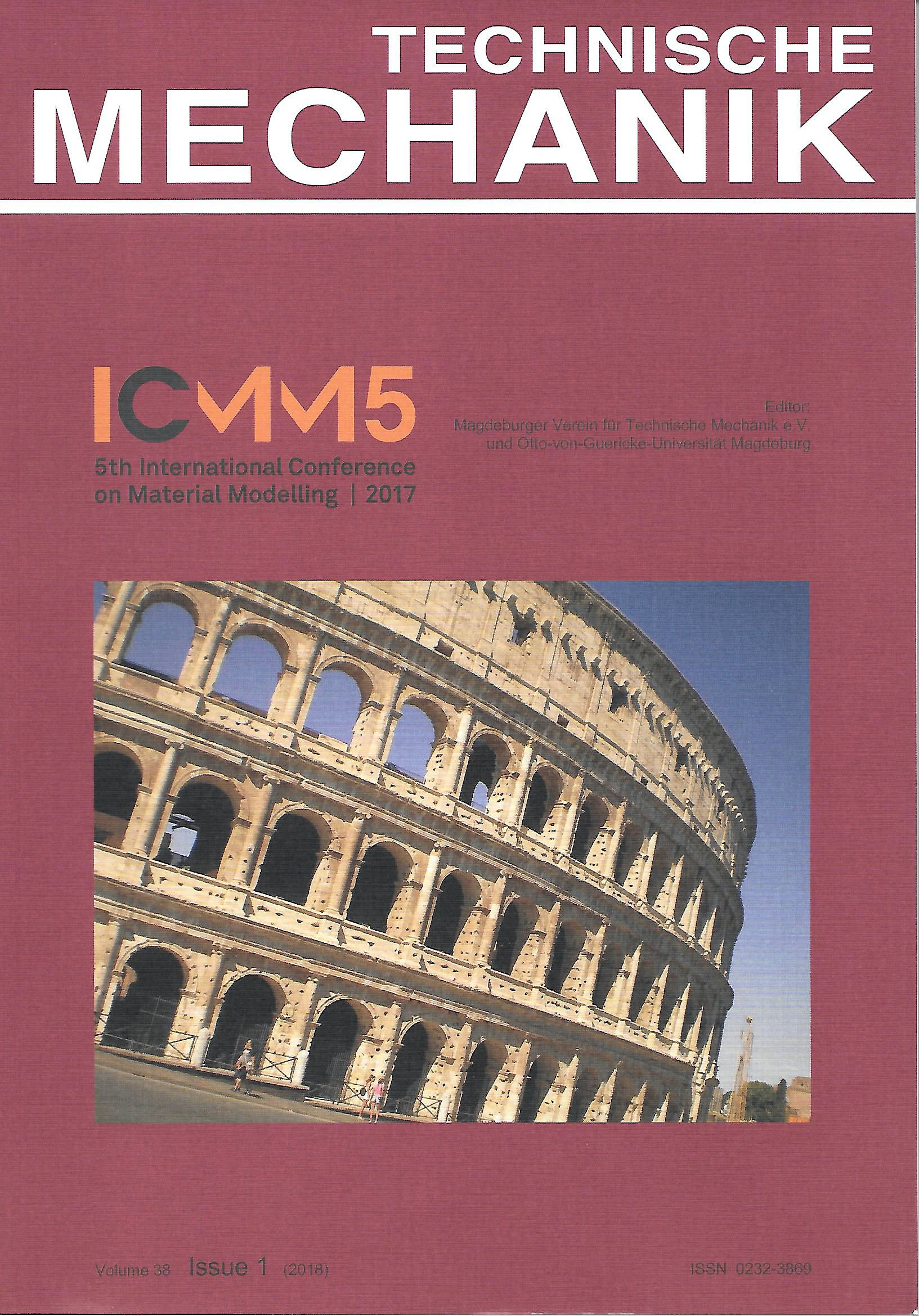
Special Issue for the 5th International Conference on Material Modeling (ICMM5)
Vol. 38 No. 1 (2018) -
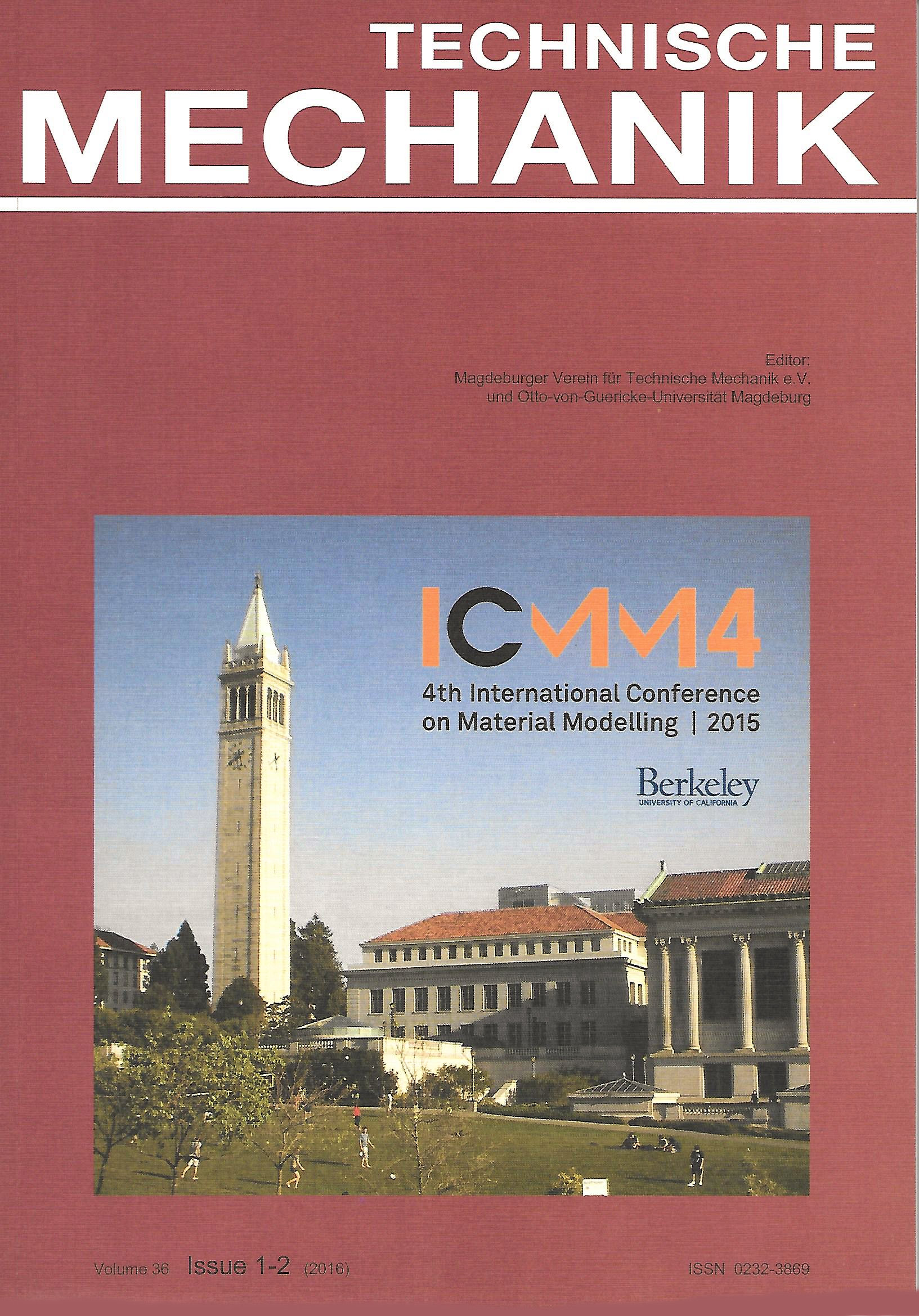
Special Issue for the 4th International Conference on Material Modeling (ICMM4)
Vol. 36 No. 1-2 (2016) -
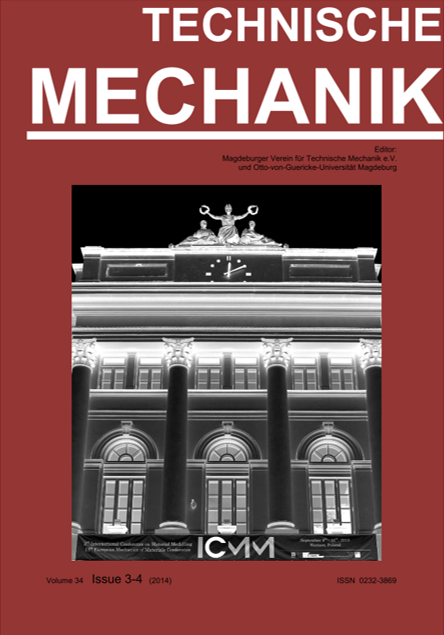
Special Issue for the 3rd International Conference on Material Modeling (ICMM3)
Vol. 34 No. 3-4 (2014)
1-25 of 132
Next